

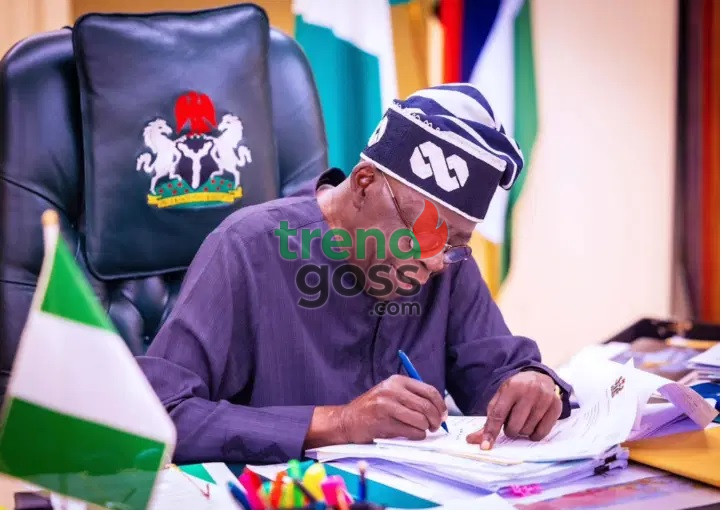
Nigeria has borrowed again.
Or more accurately, Nigeria is preparing to go deeper into debt again — and many citizens are asking a painfully simple question:
What exactly are we seeing for all this borrowing?
President Bola Ahmed Tinubu has now secured legislative approval for a fresh $6 billion external loan request, with the administration saying the money will support infrastructure and financing needs, including major projects such as the rehabilitation of the Lagos Port Complex and Tin Can Island Port. Reports today say the House approved the request and that part of the package includes a $1 billion UK export finance facility linked to port rehabilitation.
On paper, that sounds like development.
In reality, many Nigerians are no longer impressed by announcements.
Because this country has entered a dangerous phase where borrowing is now common, but visible relief is still scarce.
And that is the heart of the anger.
People are not just reacting to the size of the loan.
They are reacting to the pattern.
Nigeria’s public debt has already climbed sharply in recent years. Tinubu himself said in his letter that the country’s total public debt stood at about $110.3 billion as of December 31, 2025, while one report today said the latest approvals could push the debt stock to around $116.9 billion.
That is not a small figure.
And in a country where millions are already crushed by inflation, unstable electricity, transport pain, food costs, weak incomes, and tax pressure, the average citizen is not asking for economic grammar.
They are asking for evidence.
Where are the results?
Because if Nigeria keeps borrowing in billions while ordinary people keep living in darkness, insecurity, and economic exhaustion, then the government must expect people to start seeing these loans not as “development finance” — but as elite financial motion without public transformation.
That perception is becoming harder to dismiss.
Debt is not automatically bad. Every serious country borrows.
But debt becomes dangerous when it starts doing three things at once:
It grows faster than trust.
It grows faster than accountability.
And worst of all, it grows faster than visible national improvement.
That is where Nigeria appears to be drifting.
And the consequences are not abstract.
The more a country borrows, the more future revenue gets tied up in repayment and servicing. That means less room for real relief. Less room for schools, hospitals, electricity, wage support, social protection, and productive local investment. Analysts already say debt servicing is swallowing a huge share of federal revenue, with estimates for 2026 putting debt service above ₦15 trillion, roughly around half of projected revenue.
That is the real danger.
Not just the loan itself.
But the future that loan quietly mortgages.
And this is where public frustration turns political.
Because many Nigerians are beginning to feel that the country is being run like a machine that is always collecting, always borrowing, always adjusting, always reforming — yet somehow never arriving.
Fuel is still painful.
Electricity is still unstable.
The naira is still fragile.
Food is still expensive.
Security is still frightening.
So what exactly are citizens supposed to clap for?
This is why the outrage is growing.
Not because people do not understand infrastructure.
But because they are tired of hearing that suffering today is an investment in tomorrow — when tomorrow keeps moving further away.
And perhaps that is the deepest fear behind this latest loan.
That Nigeria is not just borrowing money.
It may be borrowing time, patience, and credibility from a population that is already running out of all three.
#Tinubu #NigeriaDebt #6BillionLoan #TrendingNigeria #NaijaPolitics #NigeriaEconomy #DebtCrisis #CostOfLiving #PublicOpinion #Trendgoss